The ₹50 Crore Question Every FMCG Brand Must Answer Before Launch
Acutus Ai
November 2, 2026
Reading Time: 5
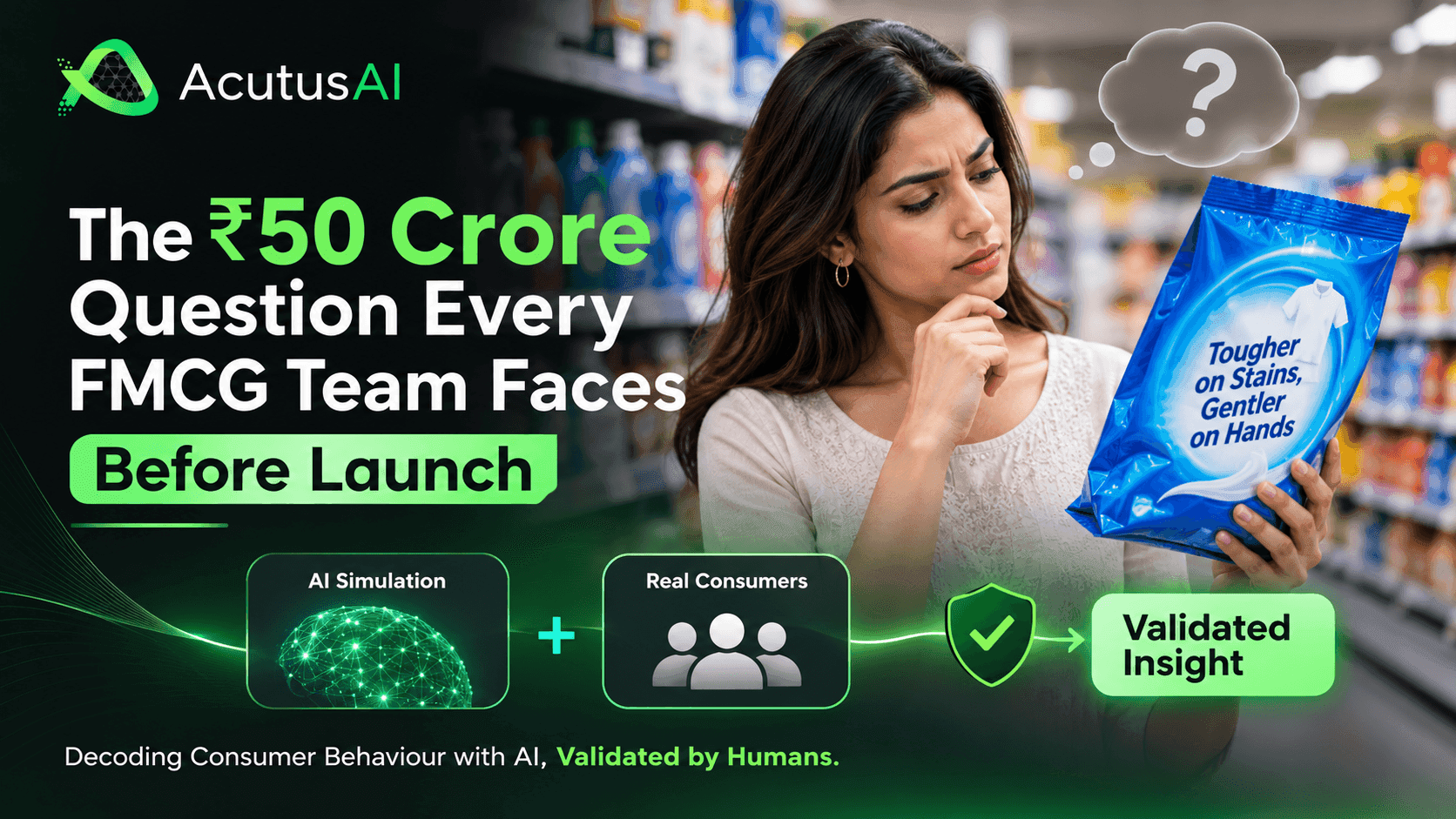
Discover how FMCG brands can validate AI-generated consumer insights with human research before product launches, reformulations, and costly campaigns.
Imagine a familiar scenario in the FMCG (Fast-Moving Consumer Goods) industry.
A legacy detergent brand is preparing to relaunch its flagship product with a new formulation and a bold promise: "Tougher on stains, gentler on hands."
Initial AI-powered consumer research looks promising. Simulated consumer panels show positive sentiment, strong purchase intent, and encouraging feedback. The marketing team is confident, and preparations for a nationwide product launch are already underway.
But before approving the launch, one senior researcher asks a critical question:
"Have we validated these AI-generated consumer insights against how real consumers actually respond?"
It's a simple question, but answering it could make the difference between a successful product launch and a costly market failure.
In FMCG, a product reformulation or brand relaunch involves significant investments in manufacturing, packaging, distribution, media spending, and retail relationships. A wrong decision can cost crores, damage brand credibility, and take months to recover from.
This is where AI-powered market research needs human validation.
Why AI Consumer Research Alone Isn't Enough for FMCG Product Launches
AI-powered consumer research has transformed how FMCG companies understand consumer preferences, test product concepts, and evaluate marketing claims.
With synthetic consumers and AI-simulated focus groups, brands can explore purchase intent, brand perception, product positioning, and campaign messaging much faster than traditional research methods.
However, speed doesn't automatically guarantee accuracy.
AI simulations can indicate what consumers might say, but they may not fully capture why consumers behave differently in real purchasing situations.
Consider the detergent example:
A consumer might respond positively to the claim "gentler on hands" in a simulated survey but question its credibility when comparing products on a retail shelf.
A product benefit might generate strong purchase intent in an AI simulation but fail to influence actual buying decisions.
A familiar brand might receive positive simulated feedback simply because consumers already recognise and trust it.
These differences matter.
Across personal care, home care, and food and beverage categories, the relationship between AI-simulated consumer responses and real consumer behaviour can reveal valuable insights. More importantly, the gaps between them can expose assumptions that traditional AI-only research might overlook.
How Acutus AI Insights Validates AI-Generated Consumer Insights
At Acutus AI Insights, we believe AI-powered market research should do more than generate confident predictions. It should help FMCG teams make decisions they can validate, understand, and defend.
Here's how we would approach the detergent reformulation and relaunch scenario.
1. Test Consumer Behaviour Across Different Behavioural Archetypes
Demographics alone don't explain purchasing decisions.
Two consumers of the same age, income group, and location may respond very differently to the same product claim.
We start by testing the proposed claim across different behavioural archetypes, including:
Sceptical consumers: Question product claims and look for credible evidence.
Habitual buyers: Prefer familiar products and are reluctant to switch brands.
Value-conscious consumers: Evaluate whether the promised benefits justify the price.
Benefit-driven consumers: Prioritise specific product performance and functional advantages.
This helps FMCG brands understand how different consumer mindsets respond to claims such as "tougher on stains, gentler on hands."
2. Measure the Consistency and Repeatability of AI Simulations
A reliable consumer insight should demonstrate reasonable consistency.
If an AI simulation produces significantly different responses across repeated runs under comparable conditions, that inconsistency deserves attention.
We examine whether the simulated consumer responses remain stable across multiple runs and whether the underlying patterns are repeatable.
This helps identify unreliable signals before they influence product positioning, marketing campaigns, or launch decisions.
3. Validate AI Insights with Real Consumer Research
AI-generated consumer insights become more useful when evaluated against independent human research.
We recommend conducting a parallel qualitative study using the same product claim, without leading questions or confirmation bias.
This provides an opportunity to understand:
Whether consumers genuinely believe the product promise.
Which product benefits resonate most strongly.
What concerns or objections influence purchase decisions.
Whether simulated purchase intent translates into real consumer interest.
The objective isn't to make AI and human research produce identical answers. It's to understand how closely they align and where meaningful differences emerge.
4. Investigate the Gaps Between AI Predictions and Real Consumer Responses
This is often the most valuable part of the validation process.
Suppose AI simulations indicate that consumers strongly believe the detergent's new formulation is gentler on hands, but real consumers express doubts about the claim.
Instead of dismissing the difference, we investigate it.
Is the claim too broad? Does it lack supporting evidence? Are consumers sceptical because of previous product experiences? Is the benefit less important than stain-removal performance?
These disagreements can reveal hidden barriers to purchase, messaging weaknesses, and unmet consumer expectations.
Identifying these issues before a national rollout gives marketing and product teams an opportunity to refine their strategy before committing significant media budgets.
5. Turn Consumer Research into Defensible Business Decisions
The final objective of consumer research isn't another dashboard or a collection of positive sentiment scores.
It's a decision that marketing, product development, and R&D teams can confidently evaluate.
Acutus AI Insights brings together AI-simulated consumer responses, repeatability analysis, and independent human validation to develop a more comprehensive understanding of consumer behaviour.
The result is a clearer picture of:
Which product claims are worth pursuing.
Which consumer segments are most receptive.
Where messaging needs improvement.
Which assumptions require further validation.
Whether the product proposition is ready for market testing or launch.
The outcome isn't simply "AI says yes." It's a more informed, evidence-backed launch decision.
Why Human-Validated AI Research Matters for FMCG Brands
For FMCG companies, even a small misjudgement in product positioning, formulation, or consumer communication can have significant commercial consequences.
A product relaunch involves multiple interconnected decisions, and validating consumer assumptions early can help reduce uncertainty before larger investments are made.
Combining AI-powered consumer research with independent human validation gives brands a practical way to:
Accelerate early-stage consumer research.
Explore more consumer behavioural scenarios.
Identify inconsistencies in AI-generated insights.
Understand the reasons behind consumer objections.
Strengthen product positioning and marketing claims.
Make more informed product launch decisions.
At Acutus, we don't believe AI should replace the researcher's judgement.
We believe it should strengthen it.
Our approach gives FMCG teams a faster and more rigorous way to evaluate consumer insights, identify potential risks, and determine when a product proposition is ready to move forward.
Planning an FMCG Product Launch, Reformulation, or Brand Relaunch?
Before committing crores to manufacturing, distribution, and media spending, make sure your consumer insights are worth acting on.
Explore how Acutus AI Insights can help validate your AI-generated consumer insights with a human-led research approach.
Enquire with us: Discuss your upcoming product launch, reformulation, or marketing claim.
Book a demo: See how AI-powered consumer simulations and human validation can work together using an example from a relevant product category.
Acutus AI Insights: Decoding consumer behaviour with AI, validated by humans.